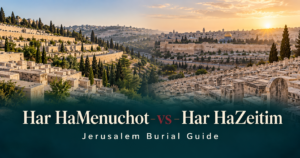
For a family planning burial in Jerusalem, two of the best-known choices are Har HaMenuchot and Har HaZeitim. Both cemeteries hold deep significance, but they differ in location, history, accessibility, burial options and current availability. This practical guide compares the two and explains the questions families should ask before choosing a plot or making a payment.
If you are still considering other locations, start with our broader guide to burial in Jerusalem.
Har HaMenuchot and Har HaZeitim at a glance
| Consideration | Har HaMenuchot | Har HaZeitim | ||||
|---|---|---|---|---|---|---|
| Location | Western Jerusalem, beside Givat Shaul | East of the Old City, overlooking its historic sites | ||||
| Character | Large cemetery complex developed in the twentieth century | Ancient Jewish burial ground with a distinctive religious and historical connection | ||||
| Plot choice | Many sections and burial arrangements; the precise offer matters | Options depend heavily on the particular section and current availability | ||||
| Visiting | Large site; confirm the entrance, burial society and section | Road proximity, stairs and terrain differ by plot | ||||
| Cost | Varies by section, burial type and terms | Varies considerably by exact location and terms | ||||
Why families choose Har HaMenuchot
Har HaMenuchot is one of Jerusalem’s principal cemeteries. Families may prefer its position at the western entrance to the city, a particular burial society or section, or proximity to relatives already buried there. The cemetery is extensive, with different sections and arrangements, so a general promise of a “Har HaMenuchot plot” is not enough to evaluate an offer.
Ask for the exact section, block and plot; the burial method; the responsible burial society; and the route visitors would use. Read our detailed Har HaMenuchot cemetery guide for location and visitor information.
Why families choose Har HaZeitim
Har HaZeitim, the Mount of Olives, has a longstanding place in Jewish history and tradition. Its position facing the Old City and Har HaBayit is especially meaningful to many families. That spiritual preference may be decisive, but the practical details still need close attention: two plots on the mountain can differ in section, road access, stairs, proximity and price.
Our Har HaZeitim burial page describes the location and current enquiry process. If access is important for elderly relatives or frequent visits, ask for photographs or video of the actual route to the proposed plot, not just a general view of the cemetery.
How should you compare burial plot costs?
Do not compare a headline price from one cemetery with a quote for a specific plot in the other. The exact section, burial type, residency or eligibility, services and documentation may differ. Ask each provider for a written breakdown of the plot or burial rights, what is included now, what may be payable later and the payment and cancellation terms. Our burial costs in Israel guide explains the categories families should consider.
Online prices and advertised availability can become outdated. A current written quotation tied to an identifiable plot is the useful comparison.
Five questions to ask before deciding
- Where exactly is the plot? Request the cemetery, section, block and plot number, plus a map or photographs where available.
- What type of burial is offered? Confirm the physical arrangement and any section-specific requirements.
- Can relatives visit comfortably? Ask about the correct entrance, road access, stairs, walking distance and any mobility needs.
- What is the full cost? Obtain a written list of included services, later charges, payment dates and refund or transfer conditions.
- What documents will the family receive? Clarify the contract, reservation or burial-right documentation and who will coordinate with the family later.
Families abroad should also read our step-by-step guide to arranging burial in Israel from overseas before booking transport or making a payment.
Which cemetery is the better choice?
Choose according to what matters most to the person and family. Someone with a strong attachment to the Mount of Olives may prefer Har HaZeitim if a suitable plot can be confirmed. Another family may prefer a particular section of Har HaMenuchot, proximity to relatives there, or a route that works better for regular visitors. Neither cemetery can be judged from its name alone: compare actual, available plots and written terms.
Frequently asked questions
Is Har HaMenuchot the same as Givat Shaul Cemetery?
Generally, yes. Har HaMenuchot is the cemetery’s name; “Givat Shaul Cemetery” refers to its location beside the Givat Shaul area of Jerusalem.
Is Har HaZeitim the Mount of Olives?
Yes. Har HaZeitim is the Hebrew name for the Mount of Olives, east of Jerusalem’s Old City. English spellings also vary, including Har Hazeitim.
Can families overseas arrange plots in either cemetery?
Arrangements may be possible, subject to current availability and the terms of the relevant section and burial society. Confirm the specific plot, documentation and coordination process in writing.
Are adjacent plots for a couple guaranteed?
No. If adjacent burial is important, ask about two identified plots at the same time and obtain written confirmation of what is reserved.
Availability, prices, access and administrative arrangements may change. Verify the exact plot and all terms with the responsible organization before making plans or payments.