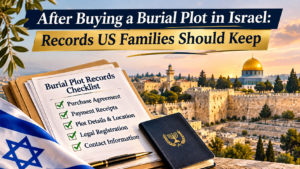
Buying a burial plot in Israel is only the beginning of good advance planning. For an American family, the practical question is whether relatives will be able to find the correct records and contact the right people years later, perhaps at a difficult moment and across time zones. This guide focuses on the documents, contacts and follow-up steps worth organizing after a purchase. It is not a substitute for reviewing your actual agreement.
1. Keep the signed purchase agreement and proof of payment together
Save a complete copy of the signed agreement, every schedule or appendix, the invoice or receipt, and correspondence confirming acceptance of the purchase. Do not rely on a bank transfer alone to establish the exact burial rights. The agreement should be the starting point for understanding what was purchased, who is recorded as the holder, and any applicable restrictions.
Store a digital copy in a secure family folder and a printed copy where your designated family contact can find it. If documents are in Hebrew, consider keeping a reliable English explanation alongside the original rather than replacing it.
2. Record the precise cemetery and plot identification
Write down the cemetery name in Hebrew and English, the burial society or authorized operator, the section, row and plot identifiers where applicable, and any map or location confirmation supplied by the operator. A general description such as “a plot in Jerusalem” is not enough for relatives who may need to make arrangements quickly.
Ask whether the assigned location is final, whether the operator can provide a written confirmation or map, and what happens if its numbering or records change. Keep the operator’s current contact details with the paperwork.
3. Verify the authorized burial operator
Israel’s Ministry of Religious Services maintains an official burial-license directory and states that bodies without a valid burial license are not authorized to conduct burials or sell burial plots. Check the operator named in your documents against the relevant official information, and ask the seller to clarify any intermediary’s role. A broker’s invoice should not be confused with the cemetery operator’s confirmation of rights.
If the purchase was arranged through an intermediary, retain both the intermediary’s contact details and the name of the organization that will actually administer the burial.
4. Understand what the plot purchase does not necessarily cover
Do not assume a prepaid plot automatically covers future transportation from the United States, airline arrangements, local funeral-home services, a monument, or every service in Israel. Ask for a written list of included and excluded services.
The National Insurance Institute explains burial-expense eligibility for deaths in Israel and Israeli residents who die abroad. A person who holds Israeli citizenship is not automatically an Israeli resident for these purposes. US families should confirm their own circumstances instead of assuming state-funded burial applies.
For the larger planning picture, see our checklist for arranging burial in Israel.
5. Keep a practical family contact sheet
A one-page contact sheet can be as valuable as a thick folder of documents. Include:
- The full name of the person for whom the plot is intended, exactly as recorded in the purchase documents.
- The cemetery, burial operator and plot reference.
- The operator’s telephone number, email and after-hours contact procedure, if provided.
- The US funeral home or community contact the family expects to call.
- The location of the signed agreement, receipts and relevant identification documents.
- The name of a trusted relative who knows where the records are kept.
Share the sheet securely with the people who would actually make arrangements. Review it periodically so that outdated telephone numbers do not create delays.
6. Ask about name changes, family circumstances and transfers
Families change over time. If the intended holder’s legal name changes, a spouse dies, or a family wishes to alter the intended arrangement, contact the operator and ask what its agreement permits. Do not assume a plot can be transferred, refunded, reassigned or exchanged. Those rights depend on the governing terms and applicable rules, and changes should be confirmed in writing.
Couples considering nearby plots should also ask whether the location and reservation status of each plot are independently documented. If you are still choosing between locations, read our Har HaMenuchot versus Har HaZeitim comparison or our Beit Shemesh burial information.
7. Prepare relatives for the cross-border process
Even with a plot already arranged, bringing a deceased person to Israel involves separate documentation and coordination. Israel’s Ministry of Foreign Affairs publishes an official application process for transferring a deceased person to Israel for burial, including documentation requirements and confirmation from an Israeli burial company willing to receive the deceased. Requirements can depend on circumstances and may change, so relatives should check the current instructions with the Israeli mission and their funeral director.
Keep a note in your family file that the purchase agreement is not, by itself, permission to transport remains internationally.
8. Review the file once a year
An annual check can be brief: confirm that the documents remain accessible, the cemetery contact still works, the family contact knows their role, and no important change requires written confirmation from the operator. This is especially helpful when a purchase was made decades in advance.
Frequently asked questions
Is a receipt enough to prove my family’s burial arrangement?
A receipt shows payment, but it may not identify all the contractual rights, plot details or restrictions. Keep it with the signed agreement and the operator’s written confirmation.
Should my children have copies of the paperwork?
At least one trusted person who may be responsible for future arrangements should know how to access the records securely. Decide what is appropriate for your family and protect personal information.
Does purchasing a plot in advance mean all future funeral costs are paid?
Not necessarily. Plot rights and burial-related services are different matters. Request an itemized explanation and check eligibility for any statutory coverage separately.
Can I change the person named on a plot later?
Do not assume so. Ask the burial operator to explain the agreement’s transfer or reassignment terms and obtain any approved change in writing.
Need help organizing a purchase or checking the next steps?
Land of Israel Burials can discuss cemetery options and the questions US families should ask when planning ahead. You can request a free consultation without committing to a purchase. If you are still deciding whether to buy, start with our 12 questions to ask before paying.
General educational information only. This article does not verify any particular plot, price, current availability or contractual right. Confirm details with the licensed operator and relevant authorities.